Saturday, March 24, 2012

Frog and Toad

Frog and Toad
By Arnold Lobel


Frog and Toad are best friends. They go on adventures, see if they are very brave, have dreams, cheer each other up, and learn about will power. They learn it’s ok to be scared – and get “The Shivers,” and how to keep a good friend.

These books are funny, easy to read, and are broken up into short stories. The stories can be read individually or all together depending on time constraints. They are good read alouds even for book loving toddlers, but would probably hold the attention of an independently reading third or fourth grader.

We have “The Adventures of Frog and Toad,” a collection with the books “Frog and Toad Are Friends,” “Frog and Toad Together,” and “Days With Frog and Toad” in it.  Each chapter is a stand-alone story.

Older children could really get into comparing Frog and Toad – maybe compare personality traits, strengths and weaknesses, etc.

Every story seems to have a theme or project that jumps out at me. Here are some of the first ones that popped into my mind while reading this treasury to Cadence – over, and over, and over again. They are just little thought snippets, not even complete sentences, but maybe they will give you some ideas!


Spring – Calendars, time, spring, melting snow

The Story – Make up a story, cheering up a sick friend

A Lost Button – Finding Toad’s Button, gifts, treasure hunt, shapes, colors, thickness, counting, process of elimination

The Letter – write a letter to a friend, mail, post offices, mail carriers

A List – make a list of things you do everyday, organization, being flexible

The Garden – gardens, plants, how things grow, helping someone who is afraid

Cookies – will power, baking cookies, feeding birds

Dragons and Giants – bravery, fairy tales, birds of prey (who eat frogs and toads!)

The Dream – vanity, boasting, bad dreams, friends

Tomorrow – procrastination, tidiness

The Kite – determination, trying again, kites

Shivers – fear, scary stories, make believe, make up a scary character and illustrate them – tell all about what makes then scary and how you might ‘defeat’ them

The Hat – big ideas, try on lots of different size hats, etc
 

Here is one project we did together –

Finding Toad’s Button

First read “A Lost Button”
Scatter buttons on the floor, or hide them, depending on child’s skill level
Look for the right button (make sure there is one in the batch that fits the description!) – use process of elimination and talk about shapes, colors, etc.
Draw a picture of Toad’s jacket
Glue on the right button, then several ‘wrong’ buttons
Older children could cut out a felt jacket and sew or glue the buttons on
After the glue dries, you can shake the jacket and see if you ‘sewed’ them on tight enough
Be sure to leave plenty of time for scattering, sorting, and otherwise playing with the buttons!


Sunday, January 8, 2012

Not Your Average Simpering Princess

I adore fairy tales, but can’t stand most of the popular movies and books little girls seem to love these days – with the whole “Princess” mentality. I was wondering to myself what the difference was. I finally decided it was the heroines. The princesses in the popular go-to books get by on their looks alone, and constantly make demands, just because they are princesses. The ladies in these books are strong of character, intelligent, and ready to take on the world. And yes, they are also kind, loving, and attractive. Here are a few of my all time favorite princess stories – minus the simpering.


Beauty by Robin McKinley

{Also: The Hero and the Crown and The Blue Sword}

Beauty is a young girl who is sweet and courageous. When her father is captured by a beast, she volunteers to take his place and save his life. Naturally the beast is rather frightening, but Beauty treats him with respect, and eventually overcomes her fright and falls in love – releasing him from a spell cast on him long ago. This book is obviously a retelling of the classic fairy tale, but the characters in this telling come to life vividly, and in spite of the familiarity, the plot keeps you on the edge of your seat throughout the book. This book is a bit higher reading level than I’ve generally posted about before, it would probably interest middle school and high school students, or adults, more than the younger crowd.

The other books I love by this author are The Hero and the Crown, and The Blue Sword. They are a bit slow getting started, but they turned out to be my favorite books ever. Well. If I could ever settle on a favorite book ever. They are just as likely to be loved by a male audience as female, with horse racing, desert and mountain survival, epic battles, long lost heroes, and plenty of magic.


Ella Enchanted (But not the movie – just the book!) by Gail Carson Levine

Ella has been ‘blessed’ with obedience. Only… it turns out not to be such a great blessing. In fact, it causes her horrible problems, especially after her parents die, leaving her to deal with cruel stepsisters. It get even worse when she falls in love with the prince – and an evil man plotting to steal the throne discovers she must obey his every command. She must break her curse – or kill her love. This book is a little more lighthearted, easier for a younger audience to read (it’s been a while since I read it, but from what I remember, probably fifth grade up), but written well enough to appeal to high school ages as well.


The Princess Academy by Shannon Hale

A young girl in a very small village is having a hard time of it. She is fatherless, and desperately wants to help her family and community, but is not allowed to work in the quarry. Then it is foretold the prince of the land will marry a girl from her province, and all the girls are gathered and taken to school to learn to be suitable bride material. They know at the end of their schooling the prince will choose one of them to be his bride. This could be the chance of a lifetime for her – but as she learns about life outside her little corner of the world, she realizes just how much her community could benefit from this education. She is astonished by how much there is to know – the worth of money, demographics of commerce – the list is unending. And in the end, she realizes it doesn’t matter who the prince chooses. Her life will finally seem worthwhile, because either way she can give her family the help they need to thrive. This book is an excellent read for elementary – perhaps about fourth grade reading level - and up. Despite the girly title, it has plenty of action scenes and roughness to appeal to the male reader also. I was a little wary of reading this book - the description made it sound really boring. I was pleasantly surprised to be immediately engrossed in the plot.


Dealing With Dragons by Patricia Wrede

Cimmaron is bored. She is bored with sewing, she is bored with learning to curtsy, she is bored with being a princess. So she sets off on a journey to find dragons – and discovers all she ever wanted and more. After all, while she is learning to deal with sneezes that catch things on fire, massive bucket size portions of deserts, and piles of treasure and loot to catalogue, the dragons are having to deal with wizards. And dragons are allergic to wizards. It’s a problem. Cimmaron is adventuresome, brave, and full of ideas though, and she and the dragons come to love and respect each other. This is the first book in the Dragon Chronicles. This entire series is fun, energetic, and easy to read. It is a great introduction to fantasy, and could probably be read even by advanced second or third graders. It would also be a great classroom read, since it is fast paced and appealing even to audiences too young to read it themselves.

Tuesday, November 23, 2010

Sequoyah Set Two


Kenny and the Dragon by Tony DiTerlizzi

Fun book based on The Reluctant Dragon. Kenny loves to read, and is always off in his own little world, without really having any good friends. Then one day a friendly dragon shows up practically in his back yard. And wouldn't you know? The dragon loves to read too, and knows all sorts of stories and fun things. They get to be best friends, and everything is going great. But then the rest of the town finds out about the dragon, and they are scared. They want to kill the dragon - and it's up to Kenny to save him. What Kenny and his family come up with is funny and just right for this sort of book. Most kids will like this book. It is lighthearted and not gory or violent, and very easy to get into and enjoy.

My opinion: This book was so fun to read! Kenny and the dragon both pull your sympathies right in, and you find yourself rooting for a happy ending for all. Loved that it was based on The Reluctant Dragon.


The Gollywhopper Games by Jody Feldman

Gil Goodson must win the Gollywhopper games! His father was fired from the Gollywhopper company after being falsely accused of stealing. Gil thinks winning the games is the only way to redeem family pride. Along the way you will find puzzles, challenges, fantastic toy rooms and fantastic rooms designed like jungles, dollhouses, pirate islands, etc. There is also cheating, racing, new friendships, and old frienships renewed. How could you go wrong with all those ingredients?

My opinion: The underlying issue this book dealt with - a family moving on with life after a false accusation almost ruined their lives - stayed with me. While I was reading the book, I was caught up in the excitement of the games, trying to figure out the answers as he did, and did not even notice this family struggle so much. I would recommend this book to kids of most ages, for fun, and to get the deeper point of family bonds even in hard times. Overall, really enjoyed reading this one, it was one of my favorites, but probably not THE favorite.


Eleven by Patricia Giff

Sam is a boy who lives with his grandfather Mack. They love to do woodworking together, and have great neighbors who are like family. But there seems to be a mystery in Sam's life. Sam is frightened by the number eleven. He also keeps having strange dreams about a boat and a cat. Then he finds a newspaper article in the attic that causes him to doubt everything he knows, even whether Mack is actually his grandfather. He and a friend set out on a search to find the truth, and eventually must confront Mack for the rest of the answers.

My opinion: Eleven was well written. The mystery just got deeper and deeper throughout, keeping you guessing, then slowly revealed itself at just the right pace. For some reason I was thinking this was the Hahn book, and kept expecting a ghost/supernatural story, but it's totally not! That's what I get for getting my authors mixed up. Despite that, I really liked it.


All the Lovely Bad Ones by Mary Downing Hahn

Travis and Corey are pranksters. They are spending the story with their grandmother, and decide to scare the guests at her bed and breakfast with a little ghost fun. But the ghost fun backfires, stirring up real ghosts. Some of the ghosts are just pesky - the bad little boys - but one is cruel. And determined to have her way, even from the grave. Now Travis and Corey have to clean up the mess they created - without being scared away themselves.

My opinion: I'm not a huge fan of ghost stories, but this was a good book for someone who does like them. I'm waffling on this one. Part of me really enjoyed it, part of me is saying it's 'just another Hahn ghost story.' Yawn. If your kid is thirsty for ghosts, he/she will love this one too!

Friday, September 24, 2010

Sequoyah Children's Books

Most of my children and young adult reading recently has been from the Oklahoma Sequoyah Book Award Masterlists. This month I will briefly review a few from the children's masterlist. I will try to do this each month until they have all been covered. To view the complete list, visit the Sequoyah website. Shockingly, I have actually enjoyed every book I have read on the children's list so far. Usually I only like one or two of them, so this year I havebeen pleasantly surprised. Unfortunately, that will make it harder to pick a favorite.


The 100 Year Old Secret by Tracy Barrett

This is the first book in a series "The Sherlock Files". It was a fast paced realistic fiction book. A brother and sister have recently moved to London, where they discover they are the direct decentants of the famous Sherlock Holmes. They are inducted into a secret club of mystery solvers, and given a notebook of all Holmes' unsolved mysteries. They decide to try to solve one, the case of a missing painting. Children will identify well with this book, since all the "stunts" and adventures are quite believable. This book would be fun for boys or girls about eight to twelve years old. The mystery is well intwined to the plot, and the reader is given enough clues they might be able to figure out the "who-done-it" about the same time as the children in the book.

My opinion: Liked this book a lot, will probably get online and order the sequel from the library. Not too cutesy, but not too dramatic either.


The Trouble with Rules by Leslie Bulion

Fourth grade is tough on a boy / girl friendship between Nadine and Nick. The unofficial rule is girls and boys can't be friends, but this pair are best friends. They try to ignore each other at school and only play in the evenings, but it is becoming a strain to not get hurt. Then a new girl moves into their class, and breaks all the rules. In the process, Nadine, who always follows the rules, gets in trouble for a series of events not actually her fault, and she and Nick fall out of sorts. Can it really work out for the rules to be broken? Can Nick and Nadine maintain their friendship, and even inclue another friend? This book handles an awkward stage in life quite well. It addresses some typical problems of growing up without seeming like a preachy, this is how to handle growing up, sort of book. The focus actually stays with the plot and captures the emotions as well. This book seems to be written more for girls, but most boys would probably enjoy it also.

My opinion: One of the few "adolecent pains" books I actually enjoyed reading. The plot was so interesting, I didn't even get annoyed at it being about growing pains. That said, I don't think it was my favorite.


Women Daredevils: Thrills, Chills and Frills by Julie Cummins

Women Daredevils is a nonfiction book about women in the early part of the twentieth century who performed daring stunts. It includes some one time stunters, but mostly women who did daring things for a living. Included are parachuters, horseback riders, stunt drivers, a woman who went over Niagra falls in a barrell, and a few others. It has nice illustrations for each woman, with about a page to two pages of information. The writing style is easy and the vocabulary appropriate for the target audience of about eight to twelve years old.

My opinion: This book seemed just a little too long for a children's non-fiction book, but I am spoiled, so it may actually have been just right. The choice of women daredevils was occasionally repetitive, for instance, their were several who did similar airplane stunts. I think I would have preferred more variety. Over all though, the book was very well written, easy to read, and was very interesting.

Friday, August 20, 2010

The Girl Who Could Fly & The Mysterious Case of the Allbright Academy

Both of these books were engaging, lively reads. They were, however, eerily similar, so I am going to review them both at the same time.


This book did a great job getting you involved in the mystery from the start. The author has a great writing style drawing you into the first person plot. The story is told from the perspective of Franny, who is an ordinary girl with an extraordinary young sister named Zoe. Zoe is recruited to attend Allbright Academy, a boarding school for rising stars. Being loyal to a fault, she refuses to go unless her older sister and twin brother are also invited to attend.

Once there, Franny and some newfound friends uncover a sinister plot. The students are changing into "Perfect robot-people"

Why? How? For What Reason? The truth is startling, scary, and exciting, and the kids have their hands full collecting evidence to bring the instigators to justice.

The Mysterious Case of Allbright Academy is technically a realistic fiction. The children recruited to the Academy are very talented, but in realistic ways. One is a scientist, another a poet, and Zoe has an extremely magnetic personality. The method of behavior modification used to change them into "perfect robot people" is probably not actually avialible yet, but it is not unreasonable to think it will be in the not-to-distant future. The actions taken by the students to rectify the situation are brave and require wit and talent - but entirely believable. Even the perspective of the narrator is completely realistic. This realism draws you in from the start and keeps you interest throughout.

There are many similarities between these two books. Both have talented children who are taken to a special boarding school. There they are tangled up in secret plots involving food laced with behavior modifying compounds. They must plan daring rebellions against the adults in charge (in one case escape, the other exposure and arrest). Then at the end the school is rebuilt to actually serve the noble, impressive purposes they said they were serving.


This was a great book. I really loved reading it, and am (not so) secretly hoping the author will write a sequel.

Piper can fly. When the world finds out about it, her parents are immediately contacted by a special "boarding school" offering to help her and claiming to be a perfect fit for her unique situation. When Piper arrives, she finds a place full of interesting, unique things and people - all with special talents. But the talents are disappearing. Again the students must ask - Why? How? To what end?

The truth is horrifying, but the children are trapped with no escape in the middle of nowhere. How will they gain their freedom? They must band together, with two very unlikely leaders, and use all their considerable talents. Even flying.

The ending is fun a climatic, with plenty of openings for a sequel - keep your fingers crossed!

I would recommend both of these books to any confident reader. There are some challenging concepts in each book - child manipulation, behavior modification, adults abusing their power, etc. They are not written to emphasize these points, most children won't notice this through the plot unless it is pointed out to them. They are exciting with plenty of action and intrigue.

Ideas:

Read both books and compare. Discuss how books with similar plots can turn out to be totally different books, even different genres, when the details are changed. Explore the differences between realistic fiction and fantasy / science fiction. Discuss how a realistic fiction book can have science and even futuristic things in it, and a science fiction book can seem quite realistic.

The Mysterious Case of the Allbright Academy is on the 2011 Sequoyah Masterlist. If you live in Oklahoma you can count this toward one of the three books you must read from the list and then vote on your favorite. Anyone could use this as an opening into book awards. How are book awards decided? What types of awards are there? Does your state have an award chosen by children? Have the students read any books with awards? Did they like the book?

These books could spark interesting discussions on behavior modification, abuse of power, and manipulation, advances in science, as well as the thought that advancement can be good and bad at the same time.

Monday, July 5, 2010

Whatever Happened to Penny Candy?

Whatever Happened to Penny Candy? A Fast, Clear, and Fun Explanation of the Economics You Need For Success in Your Career, Business, and Investments


Wow! This book is amazing. My own humble opinion is: Everyone in America should read this book!

Whatever Happened to Penny Candy? Is all about money. Where does money come from? How do we know how much it is worth? Why is there inflation? Is inflation bad, good, neutral, a necessary evil? What is the best economic system for a healthy country? If you think you can’t understand economics, think again. This book explains basic economic concepts in a simple, clear, easy to understand way. It is entertaining to read, catches and holds you attention.

I would recommend this book for all ages. Children under about seven might not grasp the concepts presented, and those with a reading level below 3rd or 4th grade might need help reading it (or have it read to them). All voters should read this book! It is a great educational or pleasure read.

Thursday, June 3, 2010

Buzz Buzz Baby

This is Cadence's favorite book. We read it over, and over, and over again - straight through, which is amazing since most books only last about two pages before they get chunked.


Buzz Buzz Baby is full of all the things babies love: real pictures of babies, bright illustrations of all their favorite things, flaps, and lots of fun sounds to make! Each page starts with a sound to make and a photo of a baby, then you open the flap and it has a picture of what makes that sound. So much fun!

Unfortunately this book seems rather hard to find. I would recommend it if you can find it, otherwise look for books of the same style - that have sounds to imitate, pictures of babies, bright, simple illustrations, flaps and textures, etc. Books of this type are great for babies and toddlers of all ages, but they seem to enjoy them to the very fullest when they are about 12-24 months old.

Activities:
Pla-Dough Shapes - Since the illustrations almost look as if they are made from clay, it would be easy for an older baby or toddler to make some of the basic shapes. Try the bee, or the car for the easiest ones. A younger baby will enjoy squishing the dough while watching you make the pictures. When you are done, compare them to the book. Point to the picture and say "bee" then say, "We made a bee too! See?" and point to your creation.

Signing Fun - This is Cadence's favorite part. We do a lot of signing in our house, and we almost always sign the objects hiding under the flap as we read. Now as soon as we turn the page Cadence will start trying to sign the word or make the sound for that page - it's been great entertainment for us! If you don't know the signs, this is a great website to see videos of each sign. Signing Savvy
We usually do "Bee" "Train" "Duck" "Car" and "Dog" (instead of puppy). Sometimes we also do "Baby".

Sock Puppets - These don't have to be fancy. If your baby is older, they could add eyes or use a marker to color the sock. If they are younger, they will really enjoy playing with a puppet you have made, or watching you use the puppet during the story. The duck is especially easy - just add eyes and foam pieces for a beak - baby will get the point.

Matching Shapes - Trace and cut out some of the shapes in the book. If you want to focus on just one shape, there is a circle on every page. Otherwise, look for things like the triangles in the dogs ears, the square train window, the heart bee wings... Look at each page. Give baby the shape that goes on that page, and see if they can match it up and put it on top of the picture. You may have to modify this by age. Cadence can put it on the shape if you point to where it goes, but she can't find it on her own. An older child might enjoy choosing which shape goes on the page instead of being handed one shape per page.

While You're Reading -
Point to different parts of the picture and tell what they are. "There's a train. That's the window. See the baby?"
Count objects on the page. "One, two wheels on the car!"
Point out different colors.
Talk about the babies in the picture. "Look, that baby is wearing the same color as you. Oh! This baby looks really happy! See, the baby in the picture is looking at the train too!"

and of course... Make the sounds for each object and encourage your baby to have fun and try it too!

Thursday, May 13, 2010

Escape Under the Forever Sky

This book is exciting and fun. It was inspired by the true story of a young Ethiopian girl who was sheltered by lions overnight while running away from kidnappers. Note: This is not a true story, the similarities end there, the incident is simply what inspired the author to write this book.

An ambassadors young daughter is kidnapped while living in Ethiopia. She manages to escape and has quite an adventure getting home. Her hero is Jane Goodall and her contemporaries, and she uses her knowledge of wildlife to survive in the wilds.

This book has something for everyone. Encounters with lion and monkeys for the animal lover, intrigue and danger for the mystery minded, action and bad guys for the adventurer, history and politics for the curious and intellectual.

I would recommend this book for everyone, but especially for children about 9-14, with a prime audience being preteen girls.


This book has tons of teaching opportunities. It would be great with a unit study, to incorporate literature in your lessons, or to ease familiarity with the following topics:

Science:
Scientific Method
Jane Goodall
Animal Science
Animals of Africa
Habitats and Animal Behaviors
Leakey's Angels
Foreign Diseases
Water Treatment

Geography / Humanities / Social Studies / Government / History:
Water Supplies
Ambassadors
Africa
Ethiopia

Literature:
Story Origins

Monday, August 31, 2009

Space Station Rat


Scritch-rip, scritch-rip… Jeffrey is the only kid on a space station where his parents are scientists. He’s stuck with Nanny, a robot who is supposed to take care of him, but turns out to be a deadly rat killing machine. Jeff winds up rescuing (and coming to love) a lavender lab rat (ingeniously named… wait for it… Rat) who has been genetically altered and trained to be a spy. Rat accepts Jeff’s friendship mainly as an escape to the outside world, and the freedom to play in the grass and sunshine. Eventually though, she discovers there is more to this kid than just a way out – maybe even a lifelong friend. Together they are challenged with destroying a robot, hiding from parents and scientists who want to kill or capture rat, and chowing on liverwurst. Ew!

There are so few science fiction books for kids – it’s great to find one so well-written and fun to read. And besides, what’s not to love about a cuddly lavender (not purple!) rat, who turns out to be witty and sometimes lethal-minded? This book is adventuresome, fast-paced, and packed with plenty of action. At the same time, it introduces kids to concepts like self-awareness, robotic and genetic (and human) ethics, and other issues commonly held to be “adult” topics, in a way that is surprisingly simple, not too deep, and overall perfect for kids, all without slowing down the plot of the book. I would recommend this book to kids from about third grade up, or any kid with a special interest in robots, space stations, spying, etc. More introspective kids will appreciate the story of growing friendship and trust between a young boy and a cute little rat. For teachers, it’s a great place to start a unit on space stations, since it provides a fun introductory knowledge of the topic.

Activities –

Space Station Map (Maps / Geography / Active Reading / Science) – Before you read, look up the real space station online. http://www.nasa.gov/mission_pages/station/main/index.html Using a large sheet of paper, draw the outline of nine rings to start your own Space Station map. Then, as you read, mark the location of each place mentioned as it’s described in the book. Some things might be general, for instance, marking the repair shop as just being on ring one, since that is as specific as the book gets.
By the end of the book, the outer ring will be the most filled in. Remind students that’s because in the book, as the old rings wore out and no longer functioned, they would build around it and move further and further out. Go back to your website about the real space station. See if you can find out if this is true in real life, and compare some similarities and differences you find between the real space station and the make believe one. You could also switch to teaching about literature at this point. Discuss how this is typical of the science fiction genre – there is a lot of real science mentioned, yet the author can take liberties and change things to make them more exciting, or to fit the plot of the story.

Velcro Boots (Math – Time Elapsed, Tables, Differences) – It takes Jeff a lot of practice to learn to run in a space-station. How hard could it be? Mark off a long section of hallway or classroom. Time students crossing from one end to the other in their regular shoes, and record the results for each kid in one column of a table. Then have them slip on special booties and try running it again, this time listening to the cool ripping sound, and taking “jumping” steps to imitate being in low gravity. Make sure they actually take slow, high jumping steps – the tape alone won’t slow them down, and you want this time to be different than the first. Record this time too – be sure to laugh at their efforts while you’re at it, and remind them this is why the parents in Space Station Rat didn’t run! Then discuss the different ways you could manipulate the information in your table. You could subtract the difference between the two times to see how much longer it took with the booties. You could then average the differences for all the students. You could use the table to make a bar graph, so it would be easier to see. See if the kids can think of any other ways to use the information.
To make the boots: The simplest way is to just wrap packing tape firmly around their feet, sticky side out. If they’re squeamish about it, you could have socks on hand, or just put it around their shoes. (I tried it, and the tape didn’t stick to my feet or hurt to peel off, even though I was clumsy and got it tangled up with the sticky side touching me. It did make a lot of noise against the floor though!)

Sound Words onomatopoeia (English) –
This book has a lot of onomatopoeias, words that sound like the sound they represent. See how many you can remember – then think of all the words we use that are onomatopoeias. Make some up!

Build-Your-Own Nanny (Science… or art… or um… whatever) – Water and alka-seltzer in small platic bottle with cork… disk (plastic bowl?) on top decorated to be robot… maybe would go forward on its own if you put it disk side up in water and shook the alk-seltzer into the water right as you let go? Who knows – not me! This, as you can clearly see, was an undeveloped thought… I just thought it would be fun to make a Nanny. Or I guess you could call it an art project and pull the old, decorate a brown paper grocery sack and pretend to be a robot trick.

Saturday, May 30, 2009

Olivia


Olivia is the most awesome pig ever. She is talented, spunky, and very funny. And she is very good at wearing people out – even herself.

These books are a great mixture of incredibly realistic childhood behaviors and extremely grandiose exaggerations. The artwork is wonderful (if you don’t like it at first because it’s different from the cuddly pictures you’re used to, don’t worry, it will grow on you!). This book holds the distinction of being a Caldecott honor book.

I would recommend this book (and the other Olivia books) for young children and older children with a good sense of humor. The activities I thought of are more games and fun than lesson plans, but oh well!

Art – Paint Your Own, and Not on the Wall Please!

Supplies:
Canvas – white t-shirt, pillowcase, etc. or to be truly artsy, an actual canvas
Lots of paint-safe space – a clothesline works best, but a fence is also nice, or an easel if you don’t mind getting paint on it
Paintbrushes
Paint – choose several colors in a paint suitable for whatever your canvas will be

It would be best to sign your canvas before you get started painting – you never know it you’ll leave enough room to do it afterward. Hang the canvas on your clothesline. Dip the paintbrush in the paint, and use a flinging motion to make the paint fly from the brush to the canvas. Repeat. A lot. With different colors of paint. Great fun, terribly messy, awesome results.

Clothes Relay Race –

Gather up some red clothes like Olivia tries on: a hat, some mittens, maybe a coat or jacket, a shirt, socks, etc. Just whatever you can find around your house will work great. Size doesn’t matter, as long as it’s not really small. Fill two bags or boxes with clothes, putting an equal number of items in each bag. Designate a starting place for a short race and put the full bags there. Designate a turn-around place and mark it clearly.
Divide your players into teams and have them line up behind the starting point. As soon as you say go, the first person from each team should begin putting on all the articles of clothes in the bag as fast as they can. Then they run to the turn-around point, and take all the clothes off. They then have to carry all the clothes back and put them back in the bag for the next person. They can carry them all at once or make as many trips as needed to get all the clothes back to the starting point. Then the next person goes and so on. The first team to get all their players dressed, undressed, and back to the starting point wins.

Thursday, May 21, 2009

The Bears in the Bed and the Great Big Storm


This book is so adorable! I just love the illustrations, the picture of Baby Bear telling his daddy Bear about the storm outside makes me want to just scoop Baby Bear up and snuggle him close. I’m sure we’ve all had the experience at some point or another – there is nothing like snuggling under the nice warm covers with someone you love, feeling all safe and comfy while listening to the storm rage outside.

I would recommend this book to anyone who enjoys a cute cuddly read. It would be especially good as a read-a-loud for young children, it has lots of opportunities for sound effects.

I don’t have any ideas for this book, I just wanted to recommend it because it is so precious.

Wednesday, February 25, 2009

Percy Jackson and the Olympians


I adore these books. I started reading the first one during book fair last year, and could not put them down until I had read all of them. Then, I frothed at the mouth until the next one came out. Now, I am anxiously awaiting the fifth (and unfortunately, supposedly last) book in the series to come out in May. I bought them for Tony’s birthday that year, and he read them almost as fast as I did, and still occasionally bugs me about not having the last one yet. As if I could do anything about it. Then, I bought the first three for Gabriel’s 11th birthday, and he made his mom go to the store right away to buy the next one, because he needed it right then. He even convinced his younger brothers to act it out with him and told them they were demi-gods.


Percy Jackson has always had bad luck in school. He’s never been to the same school two years in a row. In fact, he usually doesn’t make it all the way through the school year without getting kicked out for some sort of “incident”. It’s not that he’s bad – bad things just seem to happen while he’s around. And then he finds out it’s not his fault. His dad is a god. In fact, his dad is… oh wait, that would ruin half the first book. So he gets to go to a special summer camp, where he is taught all about being a demi-god, and has to go on a quest to return a stolen lightning bolt. In his many adventures he encounters pretty much every fantastical monster you could ever find in mythology. Very scary (without actually being scary), very dangerous, and very funny.

These books have it all – mythological creatures, action, adventure, random little tidbits of facts, humor. They are especially great for those reluctant boy readers because they get you hooked so fast – within the first chapter. They bring ancient mythology to life in a very vivid and unforgettable way.

Practical Uses:

Mythology: Gods and Monsters Made Modern
No specific ideas, but this series has a ton of mythological history in it. It would be great as a fun side note in any mythology study or even as fun reading to go along with Greek history studies.

Geography: Famous Places, Twice Over
This series mentions many, many national landmarks and attractions. The empire state building is pivotal to the story, the Hoover dam hosts a frightful battle, etc.
Have students find locations mentioned in the story on a map of the United States. Then have them mark those locations on a map outline. You could have one printed for them, or have them draw their own. They should mark the real landmark or city. Some of these locations are doubly famous in the books – the Empire State building is also Mt. Olympus. So of course, if the site has a mythological significance, they should write that in also. A fun way to incorporate art would be to have them draw a symbol representing what happened at that location in the story. This would also free up space on your map – they could just draw the symbol on the map, then draw the symbol on notebook paper and write a quick synopsis of the scene next to it. When they were finished, the notebook paper could be their key to the map.

Family Tree
Have students draw their own family tree, and compare it to a drawing (either their own or one you find in a book) of the family tree of the Greek gods and goddesses. They don’t exactly split the same way…

Thursday, February 12, 2009

Elephant and Piggie


These books are great fun for new readers – and older readers! As with all Mo Willems books, they are funny, easy, and enjoyable right from page one. As you get to know solemn, somewhat shy Elephant, and enthusiastic, outgoing Piggie, you will wonder how you ever survived without them in your life. All of them are great, but I will briefly overview two today.

“My Friend Is Sad” tells a sweet (and funny of course) story of friendship. Piggie sees that Elephant is sad, and tries to cheer him up by dressing up as all his favorite things. Elephant is at first ecstatic to see robots and such right there in front of him, but as each character leaves, he is sad again. Come to find out, Elephant was sad because he missed Piggie, and because he couldn’t share all these fun things with him.

“There Is a Bird On Your Head” is hilarious, and works great as a read aloud or reader’s theater. Two birds land on Elephants head. They build a nest. They lay eggs. Then there are lots of birds on elephants head. Piggie helps him out in the end, but then the birds land on his head instead. Mo Willems does a great job with the expressions on the characters faces! You can tell exactly how they feel about everything.

I highly recommend all of these books. They are very funny, and great for beginning readers because they are simple and mostly phonetic. Older kids enjoy them too, especially if they get into them or read them aloud with “voices”.

Practical Uses:

Check out http://www.pigeonpresents.com/index.aspx for more ideas and tons of fun!

Literature: Reader’s Theater
Type up what the characters say.
Have students make puppets or masks of Elephant and Piggie (paper plates with paint sticks for handles work great).
One student will be Elephant, and one will be Piggie. If you only have one student, you can be the other character.
Have the students read their “part” and act out the story.
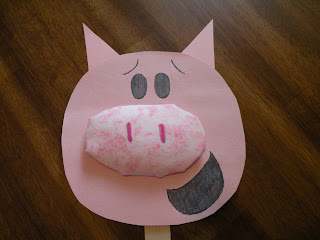
We did this at Apple Creek with the second graders, and everyone loved it. Us ‘big people’ had as much fun as the kids! This is the puppet I made to be Piggie. I will try to find the pictures I have of the actual ‘performance’ but I don’t have them with me today.

Art: The Many Expressions of Elephant and Piggie
Mo Willems is quoted to have said he won’t draw anything a young child couldn’t draw. In one interview, he said he actually has to redraw his characters sometimes to make them simpler. Yet, he always manages to convey just what they are thinking – through the way they are standing and there facial expressions. This could be two different activities.
Print, copy, or draw pictures of Elephant and Piggie with different expressions shown in their books. Write on the back of the picture what emotion they might be feeling in that scene. Use them like flashcards and see if students can interpret the picture accurately.
Write an emotion or scenario on the back of a piece of paper. Have students see if they can draw Elephant and Piggie with that emotion. Then they could play a guessing game with you or other students.

Math (and Art): Adding Birds
Start with a large sheet of blank paper. Draw four Elephants, going across the page. Under each Elephant, draw a blank line, and put a plus sign between each one and an equals sign between the last two. Read through the story, and have students put a bird on Elephants head each time another one is added in the story. It will look different from the book because you are only drawing the most recently added ones! The first picture should have one. Then one more joins, so the second picture should have one. Then the eggs hatch, so you draw in the little birds on the third picture. The last picture of Elephant should have all the birds on it. Then on the lines of course they write in 1+1+the number of little birds (I can’t remember and I’m not looking at the book right now). The last blank of course will be where they add the birds together and right in their answer.

Saturday, February 7, 2009

Elephant Run


Nick is born in Burma, but moves to London with his mother when he is young. Now World War II is ravaging London, and his parents think he might be safer in Burma with his father. Nick is excited because he thinks he will be able to spend time getting to know his father and learning all about the plantation work elephants. They are all wrong. The family teak plantation is quickly taken over by Japanese soldiers, Nick’s father is forced to march to a work camp, and Nick is held captive to ensure cooperation. The plantation elephants and their trainers are forced to work on the Japanese railroad and building airstrips. An old monk who can work with even the wildest, most dangerous of the elephants seems to be Nicks brightest hope – can they escape the plantation, free Nicks father, and get to safety? This book has tons of action and was very interesting to me because it weaves in so much about the elephants, their training, how they were used, and the such like. We frequently tend to focus on Europe and the Holocaust when we think of World War II, but this book takes you to the jungles of Asia, and the power struggle between the Allies and Japan there.

I would highly recommend this book for adults and all but the very most sensitive of children, probably from second to fourth grade on. It is fast paced and easy to follow, with plenty of action. The author pulls you into the story right from the very start, and you are in love with the characters almost right away. Since death is an unfortunate reality of every war, this book does have one or two slightly gritty scenes, but the author handles them very well in the context of the book and you’ve moved right along without even hardly noticing it. This book would be excellent as part of any study on World War II.

Practical Uses

Encyclopedia Research: The Many Uses of Elephants

This is a very simple way to get students started using an encyclopedia. I’ve helped students as young as second grade do this sort of research. The basic prerequisites is they need to know how to read and write, but you could always read and write for them if you wanted to just ‘show’ a younger student how an encyclopedia works. If you want them to do everything by themselves, they will also need to understand alphabetical order.
Start by explaining that there are many different resources to choose from when you want to learn something new. If you just want to know the definition of a word, you should choose a dictionary. If you want quick, short answers to a specific question, you might try an almanac. If you want lots of diverse information about a broader topic, you might choose an information book from the library. If you want information about a specific topic, you could look it up in the encyclopedia.
An encyclopedia has several important parts the student should become acquainted with. Have them choose a random volume from the shelf. Point out the letter on the spine, and tell them all the words and topics in that volume start with that letter. Have them open the encyclopedia somewhere near the middle, and point out the key words on the page. Explain key words are in bold at the top of the page, and tell what the first or last word on that page. Have them look at the page and tell them each bold word is the start of a new topic, or entry. Tell them the topics are in alphabetical order to make them easy to find, and have them look closely at the page to observe this. Turn several pages at once, and show them it takes a lot of pages to get very far in the alphabet.
Ask the student what letter their encyclopedia should have on its spine to look up elephants, and have them get that volume. Challenge them to find the entry for elephant. Have them read through it and see if they can find at least three different topics about elephants, such as eating habits, environment, and what work they are used for. Then have them pick their favorite, and see if they can find three facts within that topic. Explain that a fact is a short, quick piece of true information about something. It should just be one complete sentence. Have the student write their facts down, with a title at the top of the page. Say they pick what work they are used for – their page might look like this:

Work Elephants are Used For

1. Elephants are used for logging.
2. Elephants are used to transport people.
3. Elephants can be trained for entertainment.

Tell the students congratulations – they have used the encyclopedia to find facts about a new topic and do research. (If you are interested at this stage, you should have them write their citation at the bottom of the page.)

Political History / Geography: A Changing Nation

Since Burma is not on current maps, this book would be a good starting place for a discussion on the many reasons a country might change it’s name. Start by discussing the fact the United States of America used to be the American Colonies. We were the colonies of England that happened to lie in North America. Then we had a huge war to gain our independence. We decided to set up our government into states that were united under a federal government. Thus we were the United States, and since we still happened to be in North America, we were the United States of America.
Then have students use an encyclopedia (or Google if they are advanced enough to sort through results) and look up Burma to see if they can find its history.


Literature / History / Research / Art / Just a Little Math: Historical Storyboard

You could do this two ways, depending on how much time you have for research. Students could either choose specific events from the story, or they could research them from the time period in general. Also, if you did the other encyclopedia activity, you might want to reinforce those skills, or you might feel you need a break from research. I will explain the longer way. Have students use an encyclopedia* or information book to find six events in World War II. Make sure these events can be dated or otherwise put in sequential order. Have students cut a piece of white construction paper in six pieces. On each piece they should draw one of the events they chose. Have them write in small letters at the bottom the “title” of the event and the date. They will then put the events in order on another piece of construction paper using glue or tape.

Things you could branch off and discuss more in-depth:
Story boarding in the media and as a planning tool
Story boarding as a comic strip
Sequential ordering
Encyclopedia usage
Cause and effect
How changing even one event in their storyboard would affect the rest of the war


Geography: Finding Nick

Before reading the book give students a map of Europe and Asia. Have them find these places and mark them on the map:
London
Burma (this will be tough since its not called Burma anymore)
Japan
India
-Bay of Bengal
Thailand
Australia
As they read the book have students trace the route Nick might have taken, and mark any other places they find mentioned in the book.

Wednesday, January 28, 2009

Something to Tell the Grandcows

This book is hilarious. It tells the story of Emmadine the cow, who has nothing exciting to tell her grandcows. The best she can come up with is the time she swatted 13 flies at once – and who wants to hear about that? So she answers an advertisement to travel to the South Pole. This book is loosely based on a true story, Admiral Byrd’s expedition to the South Pole. He did in fact take several cows on his expeditions, but of course they did not wear udderwarmers, or teach the cowherd the hoochy-coochy. It talks about silly things like that, but it also talks about the supplies they needed to take, the sun staying up all summer (and down all winter), the president awarding the explorers when they got back, and other little details that make it almost (but not really!) like historical fiction.

The bottom line is I would definitely recommend this book. It is a very fun, silly pleasure read. In spite of the silliness, it would also be a good jump off place for a lesson on the South Pole, Antarctica , explorers, Admiral Byrd’s expeditions, etc.

I’ve decided that on the rare occasion I have any ideas on how to use the book in a lesson, I will put them at the end of the post, so here is the end of “Something to Tell the Grandcows”.

Practical Uses:

Literature: Fact Vs. Fiction
Explain the difference between fact and fiction. Discuss how some made-up books have real things in them. This book is easier for this than true historical fiction* because the fiction parts are obvious and somewhat ridiculous. Even the youngest children should be able to tell you cows don’t really teach people how to dance the hoochie-coochie. Have students point out things from the book that could and couldn’t have happened.

History: Shackleton’s Expedition, Explorers
No specific ideas, but it would be a great jumping off point to get discussion rolling on these topics before you dig into serious research.

Science: South Pole Sunlight
Use this book as an introduction to a lesson on the earth’s axis tilting away from the sun, causing solar regions to have ‘unusual’ patterns of sunlight. There is a very simple experiment to illustrate this point well.
You will need:
a flashlight – the sun
a styrophoam ball – the earth
a marker – for drawing vague continent shapes
and some toothpicks – your “axis”
Have students draw outlines of the continents on their earth (note the geography opportunity here ;)), then put a toothpick at the north pole and one at the south pole. Have them hold the earth by the axis while you shine the flash light straight at the earth. Make sure you are not shining at an angle. The student can then turn rotate their earth on its axis and observe how the sun shines on different parts of the earth.
If you wanted to get more in depth, you could then have students draw the equator and ask them how they think it got is name. Explain that the closer you get to the equator, the more equal the sunlight and darkness are.

Math: Graphs and Charts
If you did either the literature or science lesson, you could use the facts you gathered to make a graph. The facts and fiction graph would simple – say your students found three things that were fiction and four things that were fact, their graph would just have two bars - one 3 units hight, the other 4. For the sunlight, they would plot how many hours of sunlight certain days of the year had. Or they could plot how many days had 3 hours of sunlight, how many days had 5 hours, and so on. This might also work well with a line graph.

Geography: Route Planning
Have students use an atlas to decide on a route from their home to the South Pole. Depending on students’ general knowledge and research skills, this lesson could go several ways. Young students could be given a printout of a world map outline and asked to simply draw how they think they could get there. Older students could research (or just guess) what mode of transportation each leg of their route would require, and figure out approximately how long each leg of the trip would take to make. They could also list (and label on their map) all the countries and oceans their route would pass through.
You could discuss difficulties and advantages of different routes (more supplies needed for the ocean journey, more physical labor hiking down through South America, if you go through Cuba, you have to deal with hostile relations with the United States, etc…).

* One characteristic of historical fiction is everything in the book realistically could have happened to the characters in the book.